App updates occasionally reshuffle puzzle order. If this level 96 walkthrough doesn’t match what you see, no stress! Just head to our All Levels page and identify your exact puzzle by its visual layout.
Aim carefully when dropping balls—make sure they land fully inside each triangle’s boundary so the game registers them correctly.
Level Overview
What Makes This Puzzle Tricky
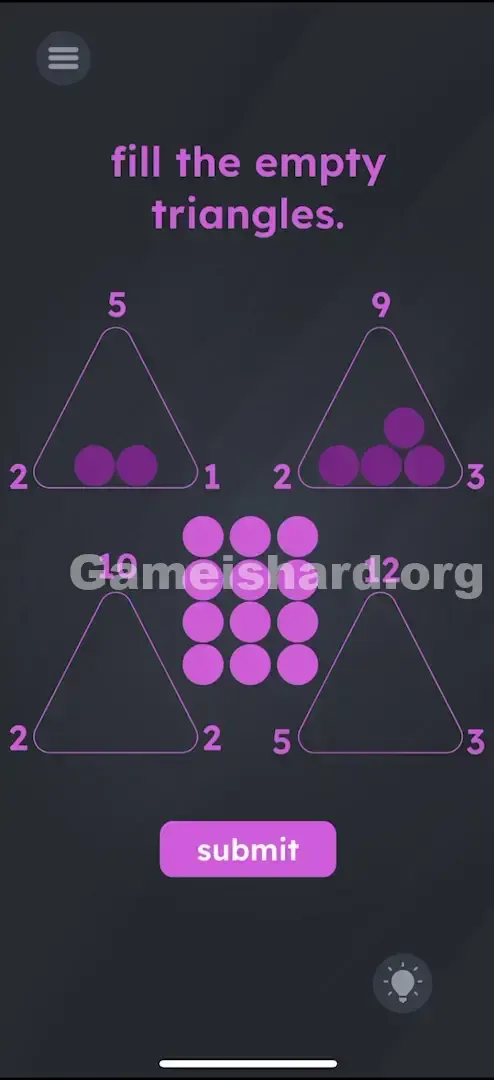
You’re greeted with a deceptively simple screen: two blank triangles, numbered corners, and a cluster of purple balls in the center. At first glance, it feels like a basic drag-and-drop task—but without cracking the underlying math pattern, random placement won’t cut it. This isn’t about physics or timing; it’s a quiet logic puzzle dressed as a casual game.
Your Goal
Your mission is to “fill the empty triangles” with the precise number of purple balls dictated by a hidden arithmetic rule. Two completed examples at the top serve as your only clues—you’ll need to reverse-engineer the formula connecting corner values to ball count, then apply it flawlessly to the two bottom triangles.
Key Mechanics
- Pattern Recognition: Spotting the consistent mathematical relationship between vertex numbers and interior balls.
- Drag and Drop: Every purple ball in the center is interactive—move them one by one.
- Container Logic: Triangles function like containers—the game tallies only balls fully enclosed within their borders. It’s not a mistake—it’s intentional design. You’re loading each triangle with a specific “ammo count,” calculated using subtraction.
What Appears on Your Screen
Let’s map out the layout clearly:
- Top Text: "fill the empty triangles."
- Top Left Triangle (Example 1): Numbers 5 (top), 2 (left), 1 (right); contains 2 purple balls.
- Top Right Triangle (Example 2): Numbers 9 (top), 2 (left), 3 (right); contains 4 purple balls.
- Center: A group of 12 movable purple balls.
- Bottom Left Triangle (Empty): Numbers 10 (top), 2 (left), 2 (right).
- Bottom Right Triangle (Empty): Numbers 12 (top), 5 (left), 3 (right).
- Bottom Button: A prominent pink submit button.
Common Mistakes to Avoid
The Trap
The biggest hurdle is overcomplicating the math. Players instinctively reach for multiplication (2 × 1 = 2?), addition (5 − 2 − 1 = 2?), or even geometry-based reasoning. But the real rule is straightforward—if you misapply the order of operations (e.g., subtracting only one bottom number instead of their sum), you’ll get the wrong count every time.
First Instincts That Fail
- Overfilling blindly: Since the prompt says “fill,” many dump all available balls in—nope, that fails.
- Counting shape features: Some assume ball count relates to triangle sides or angles—irrelevant here.
- Skipping the submit step: Unlike earlier levels, success requires manual confirmation—just placing balls isn’t enough.
Player Reactions
I wasted nearly three minutes testing division: 5 ÷ 2 ≈ 2, 9 ÷ 2 ≈ 4—seemed promising until I hit the second target. 12 ÷ 5 = 2.4 → I dropped 2 balls. Instant failure. Embarrassing—but also a great reminder to check assumptions.
Step-by-Step Solution
Preparing the Move
Those 12 purple balls in the center are your working set. The formula driving everything is: Top Number − (Bottom Left + Bottom Right) = Ball Count.
Executing the Solution
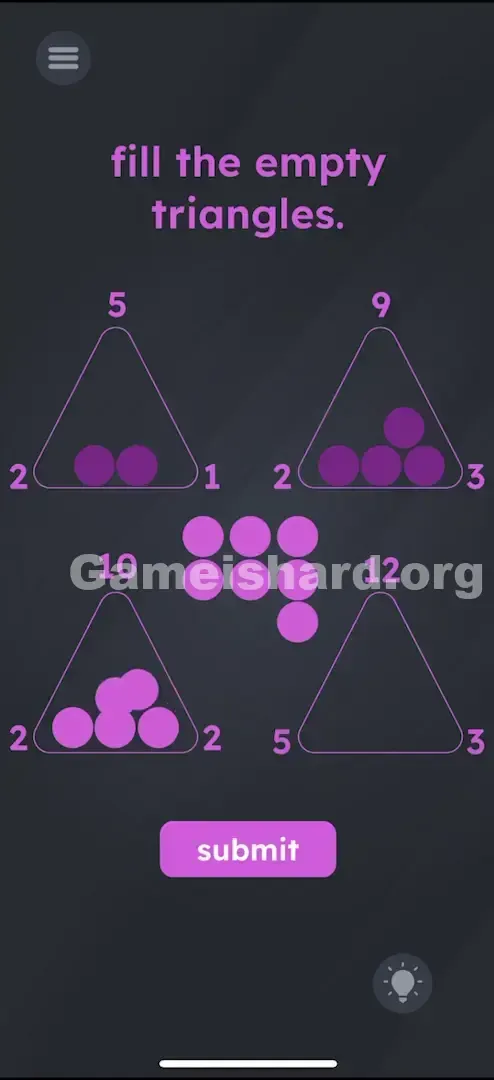
Analyze the Bottom Left Triangle: The numbers are 10 (top), 2 (left), and 2 (right). Math: 10 - (2 + 2) = 10 - 4 = 6 . Action: Drag exactly 6 purple balls from the center pile into this triangle. Analyze the Bottom Left Triangle:
The numbers are 10 (top), 2 (left), and 2 (right).
Math: 10 - (2 + 2) = 10 - 4 = 6 .
Action: Drag exactly 6 purple balls from the center pile into this triangle.
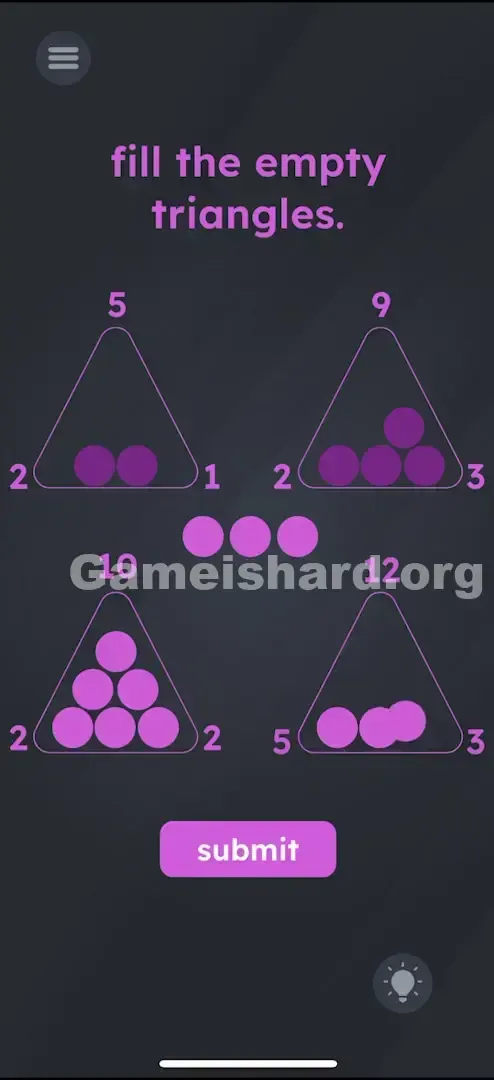
Analyze the Bottom Right Triangle: The numbers are 12 (top), 5 (left), and 3 (right). Math: 12 - (5 + 3) = 12 - 8 = 4 . Action: Drag exactly 4 purple balls from the center pile into this triangle. Analyze the Bottom Right Triangle:
The numbers are 12 (top), 5 (left), and 3 (right).
Math: 12 - (5 + 3) = 12 - 8 = 4 .
Action: Drag exactly 4 purple balls from the center pile into this triangle.
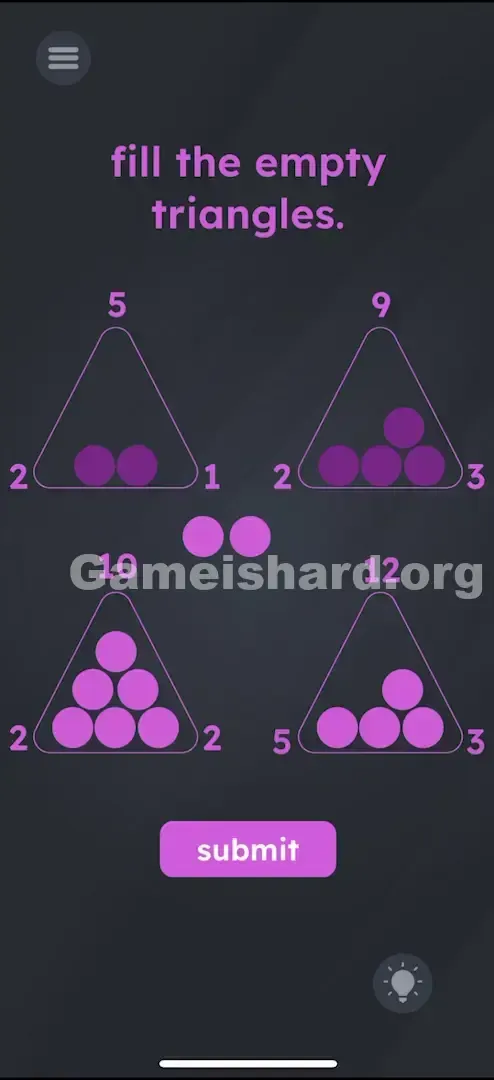
Verification: Count them again. Left should have 6. Right should have 4. Tap the submit button. Verification:
Count them again. Left should have 6. Right should have 4.
Tap the submit button.
If It Did Not Work
- Balls bouncing out: Dropping near triangle edges can cause physics glitches—keep placements well inside the shape.
- Miscounting stacks: It’s easy to drop balls on top of each other, creating a pile that hides the true count. Spread them out before submitting.
Small Details That Matter
Accuracy matters—but it’s about clean counting, not positioning finesse. The triangle’s “hitbox” matches its visible outline.
- The "Stacking" Glitch: Balls collide and stack. While the game counts anything inside the boundary, stacked balls can fool your eye—spread them slightly to verify visually.
- I fixed it by... pulling all balls back to the center and re-adding them one at a time, counting aloud. Trying to adjust mid-triangle led to confusion.
Why This Solution Works
This level swaps reflexes for reasoning—a logic puzzle hiding behind playful visuals.
- Example 1: 5 - (2+1) = 2 balls.
- Example 2: 9 - (2+3) = 4 balls. So the pattern holds: Top minus sum of bottom corners equals ball count. It tests your ability to pause, observe, and deduce—not just react.
Bonus Tip
Speed-running or replaying? Streamline it:
- Skip analyzing the top examples—they’re pure instruction.
- Grab balls right away.
- Place 6 in the left triangle.
- Place 4 in the right triangle.
- Hit submit immediately—no arranging needed. As long as balls cross the line, they’re counted.
Alternative Attempts on Game Is Hard Level 96 (What Doesn’t Work, and Why)
Here’s what I tried—and why it failed:
- Putting 5 balls in the right triangle: Guessing based on 12 − 5 alone ignored the third number.
- Dragging corner numbers: They’re static labels—only purple balls are draggable.
- Shaking the device: No effect—just wastes time and draws stares.
- Tapping balls: Does nothing. Dragging is mandatory.
- Merging balls: No combination mechanics exist—each ball stays independent.
Common Mistakes for Game Is Hard Level 96
- Math slip-up: Computing 12 − 5 + 3 = 10 instead of 12 − (5 + 3) = 4—order of operations trips up even sharp players.
- Border-line drops: A ball resting directly on the triangle’s white edge may register as outside.
- Losing track mid-drag: Adding balls haphazardly leads to over- or under-filling.
- Forgetting to submit: Waiting for automatic feedback won’t work—tap that button!
- Using example balls: The top triangles’ balls aren’t interactive—you must use only the center pile.
Pattern Recognition: How to Spot This Trick in Future Game Is Hard Levels
The Tell
When geometric shapes appear with pre-filled examples and corner numbers, pause before touching anything. That’s your signal to analyze—not act.
The Habit
Always treat labeled shapes as data containers. Ask:
- Does the content equal their sum?
- Their difference?
- Their product?
Work out the math in the given examples first—then apply it.
Game Is Hard Level 96 FAQ (Short, Useful)
Q: Can I run out of balls in Game is hard Level 96? A: No, the center pile has 12 balls, which is exactly enough (6+4=10) with 2 spares. You won’t run short unless you lose them off-screen.
Q: Does the arrangement inside the triangle matter in Game is hard Level 96? A: No. They can be in a messy pile or a neat row. As long as they are inside the lines, they count.
Q: I put the right amount in but it failed in Game is hard Level 96? A: You likely have two balls stacked perfectly on top of each other, meaning the game counts one extra ball that you can't see. Drag them around to check.
Q: What is the math formula again in Game is hard Level 96? A: Top Number minus the sum of the Bottom Numbers.
More Game Is Hard Solutions
Stuck on the next puzzle? Our guides skip fluff and deliver direct, reliable solutions. Bookmark us for when the game throws another curveball—because it absolutely will. Share this with friends still multiplying vertices!