App updates can sometimes shuffle the order of puzzles. If this level 101 walkthrough doesn't match your screen, don't worry! You can browse our All Levels guide to find your exact puzzle by its picture.
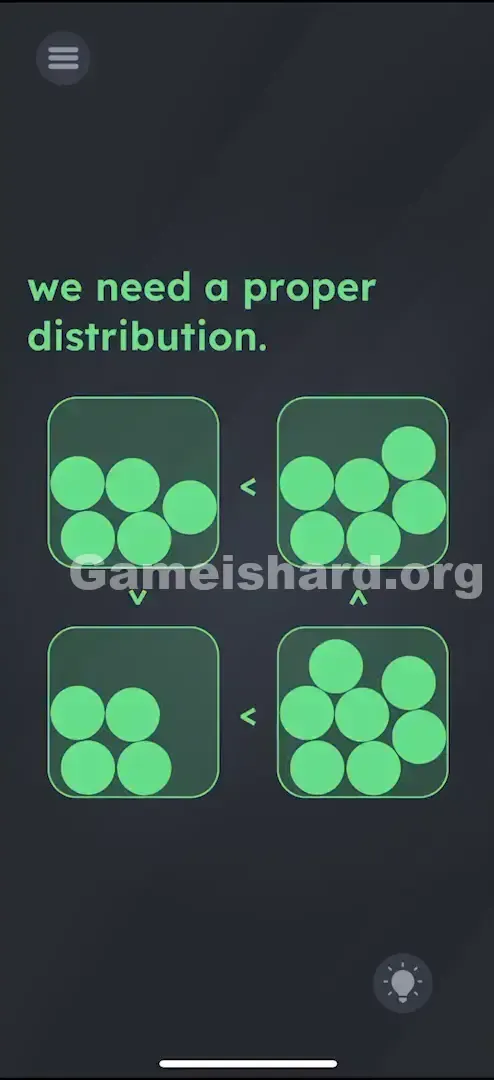
This satisfies all the "greater than / less than" symbols connecting the boxes.
Level Overview
What Makes This Puzzle Tricky
At first glance, this seems like a physics-based challenge—you see four containers full of orange balls and the prompt “we need a proper distribution.” It tempts you to balance them evenly or nudge them into alignment. But equalizing the counts won’t work. Beneath the surface, it’s actually a logic-driven number puzzle.
Your Goal
Your goal is to redistribute the orange balls across the four boxes so that each count matches the mathematical relationships shown by the symbols (<, >, ^, v) linking them. Think of it as solving a mini system of inequalities—X, Y, Z, and W must fit specific constraints.
Key Mechanics
- Object Dragging: Tap and hold any orange ball, then drag it directly into another box.
- Mathematical Logic: Symbols like < mean “less than,” while v and ^ are rotated inequality signs—v means “top is greater than bottom,” and ^ means “bottom is greater than top.”
- Counting: Precision matters. Estimating ball counts visually almost always leads to errors—count each one carefully.
It’s not a bug. It’s algebra dressed up as a playful ball-sorting task.
What Appears on Your Screen
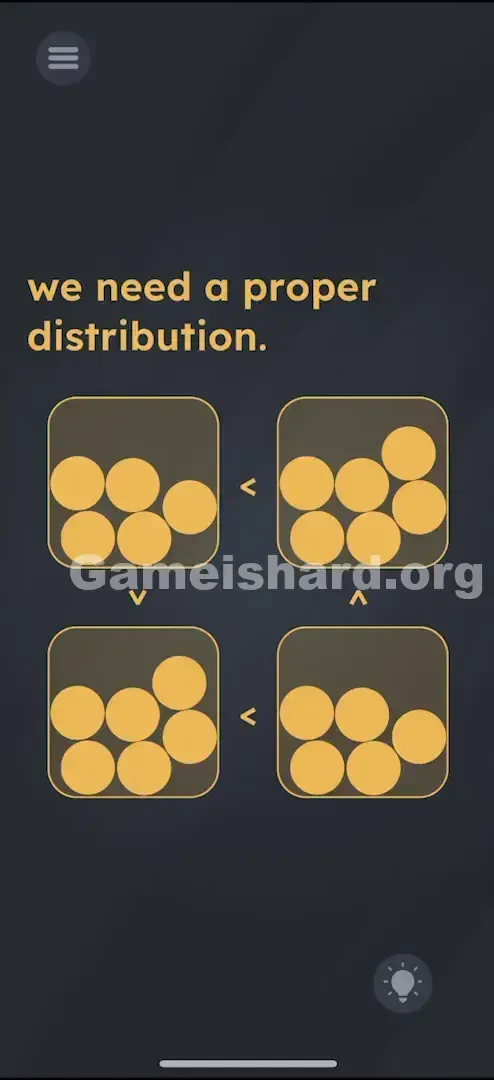
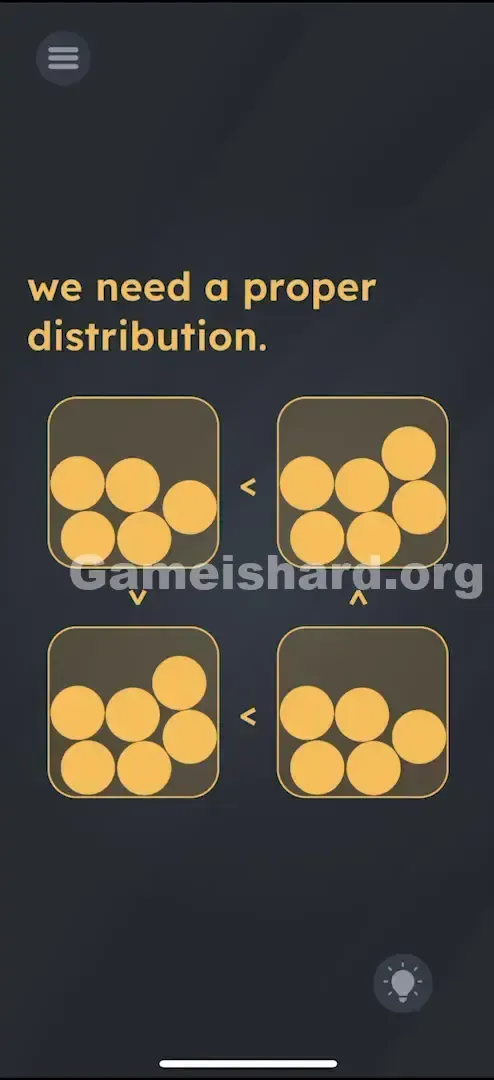
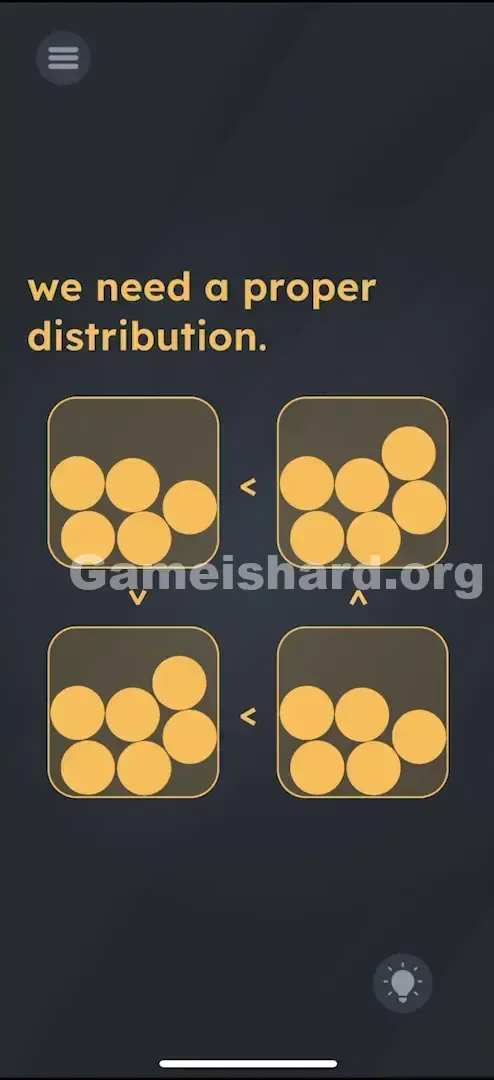
Picture four transparent square containers arranged in a 2×2 grid, each holding orange balls.
- Top Row: Two boxes linked by a < symbol—so the left box must contain fewer balls than the right.
- Bottom Row: Also connected by a < symbol—same rule applies here.
- Vertical Connections: A small v sits between the Top-Left and Bottom-Left boxes. This is a rotated > sign pointing downward, meaning the Top-Left count must be greater than the Bottom-Left count. Between Top-Right and Bottom-Right, there’s a ^—a rotated < pointing upward—meaning the Bottom-Right count must be greater than the Top-Right count.
- Between the Top-Left and Bottom-Left boxes, there is a small v . This is a rotated > sign pointing down. It implies the Top box is "Greater Than" the Bottom box (because the open side faces the larger number).
- Between the Top-Right and Bottom-Right boxes, there is a small ^ . This is a rotated < sign pointing up. It implies the Bottom box is "Greater Than" the Top box. The phrase at the top reads: "we need a proper distribution."
Common Mistakes to Avoid
The Trap
The biggest stumbling block is the vertical symbols. Most players instantly recognize the horizontal < and > signs—but v and ^ often get misread as directional arrows or decorative elements, not math operators.
First Instincts That Fail
- Chasing equality: “Proper distribution” sounds like “equal distribution,” leading many to aim for identical counts across all boxes—even though that violates the given inequalities.
- Overlooking vertical rules: Solving just the top and bottom rows (e.g., 3 and 4) may satisfy horizontal conditions but break the vertical ones—unless you check both.
Player Reactions
I spent nearly two minutes tilting my phone, hoping gravity would sort things out—convinced it was a physics glitch. Then I zoomed in on the v symbol and realized: “Wait—that’s not an arrow. That’s a sideways ‘greater than’ sign!”
Step-by-Step Solution
Preparing the Move
Forget physics—treat every ball as a unit of value. You’re working with exactly 22 balls total.
Executing the Solution
Move balls one at a time until these exact numbers appear:
- Top-Left Box: Add or remove balls until the count hits exactly 5 .
- Top-Right Box: Adjust until it holds exactly 6 . Confirm: Is 5 < 6? Yes—horizontal condition satisfied.
- Check: Is 5 < 6? Yes. Horizontal rule solved.
- Bottom-Left Box: Reduce or add until it contains exactly 4 . Verify: The v symbol means Top > Bottom—is 5 > 4? Yes—vertical condition met.
- Check: The symbol is v (Top > Bottom). Is 5 > 4? Yes. Vertical rule solved.
- Bottom-Right Box: Place all remaining balls here—you’ll land at 7 . Confirm: The ^ symbol means Bottom > Top—is 7 > 6? Yes—vertical condition satisfied.
- Check: The symbol is ^ (Bottom > Top). Is 7 > 6? Yes. Vertical rule solved.
Confirming It Worked
As soon as the final ball settles into place with the correct count, the level completes automatically.
If It Did Not Work
- Miscount: Balls often stack, making totals hard to read. If the level doesn’t unlock, pull one ball from a questionable box and drop it back in—it forces a fresh count.
- Physics Glitch: Occasionally, a ball lodges near the edge. Drag it fully into the center of its target box to ensure registration.
Why This Solution Works
This level tests how well you interpret symbols in multiple orientations. We’re fluent reading left-to-right comparisons (like 3 < 5), but rarely asked to parse top-to-bottom logic using rotated signs. The game leans on symbol blindness—your brain sees v and defaults to “down arrow,” not “greater-than.” By layering four interdependent inequalities, Game is Hard transforms simple dragging into sharp logical reasoning.
Bonus Tip
If future “distribution” levels trip you up:
- Count the Total: Always start by confirming how many items you’re working with—in this case, 22.
- Find the “King”: Spot the box where all inequality openings point toward it—that’s your largest value.
- Find the “Runt”: Identify the box where all inequality points converge outward—that’s your smallest value.
Game Is Hard Level 101 FAQ (Short, Useful)
Q: Can I shake the phone to auto-distribute balls in Game is hard Level 101? A: No. Shaking has no effect here—every ball must be moved manually with your finger.
Q: What do the v and ^ symbols mean in Game is hard Level 101? A: They’re rotated inequality signs. The wide end of v points to the larger number (so Top > Bottom); the wide end of ^ points down, meaning Bottom > Top.
Q: My balls are stuck on the rim! A: It happens. Just tap and drag the stubborn ball into the center of its intended box—the game registers placement more reliably there.
Q: Is there more than one valid solution? A: In theory, yes—if only inequalities mattered. But with exactly 22 balls and fixed constraints, only the 5-6-4-7 arrangement fits all conditions.
More Game Is Hard Solutions
Stuck on the next puzzle? We’ve got fast, no-nonsense guides for every level of Game is hard . Don’t let a flipped symbol stall your progress—explore our full walkthrough library and share this guide with anyone counting oranges instead of inequalities.