App updates can occasionally reorder puzzles. If this level 263 walkthrough doesn’t match what’s on your screen, no problem! Check our All Levels directory to locate your exact puzzle using its visual layout.
Level Overview
What Makes This Puzzle Tricky
You’re told to “think small.” So you tap the numerically lowest number—and get a red flash and instant failure. Why? Because Game Is Hard Level 263 deliberately resets the rules four times in a row. It lures you into spotting a pattern—only to shatter it immediately. This isn’t about arithmetic—it’s a psychological game of shifting expectations, like Simon Says where the meaning of “small” evolves each round.
Your Goal
You must clear four successive waves of numbered bubbles by selecting the “smallest” option each time—but “smallest” means something different every round: sometimes it’s numeric value, sometimes visual scale, sometimes requiring simultaneous input.
Here’s what’s really at play:
- Shifting logic systems
- Visual misdirection
- Precise multi-touch timing
- Strategic pauses
- UI-focused perception gaps
It’s not a mistake—it’s intentional design.
What Appears on Your Screen
The interface is stark and stripped-down. A pitch-black background. At the very top center, the instruction think small. appears in soft pink, lowercase type—deceptively simple.
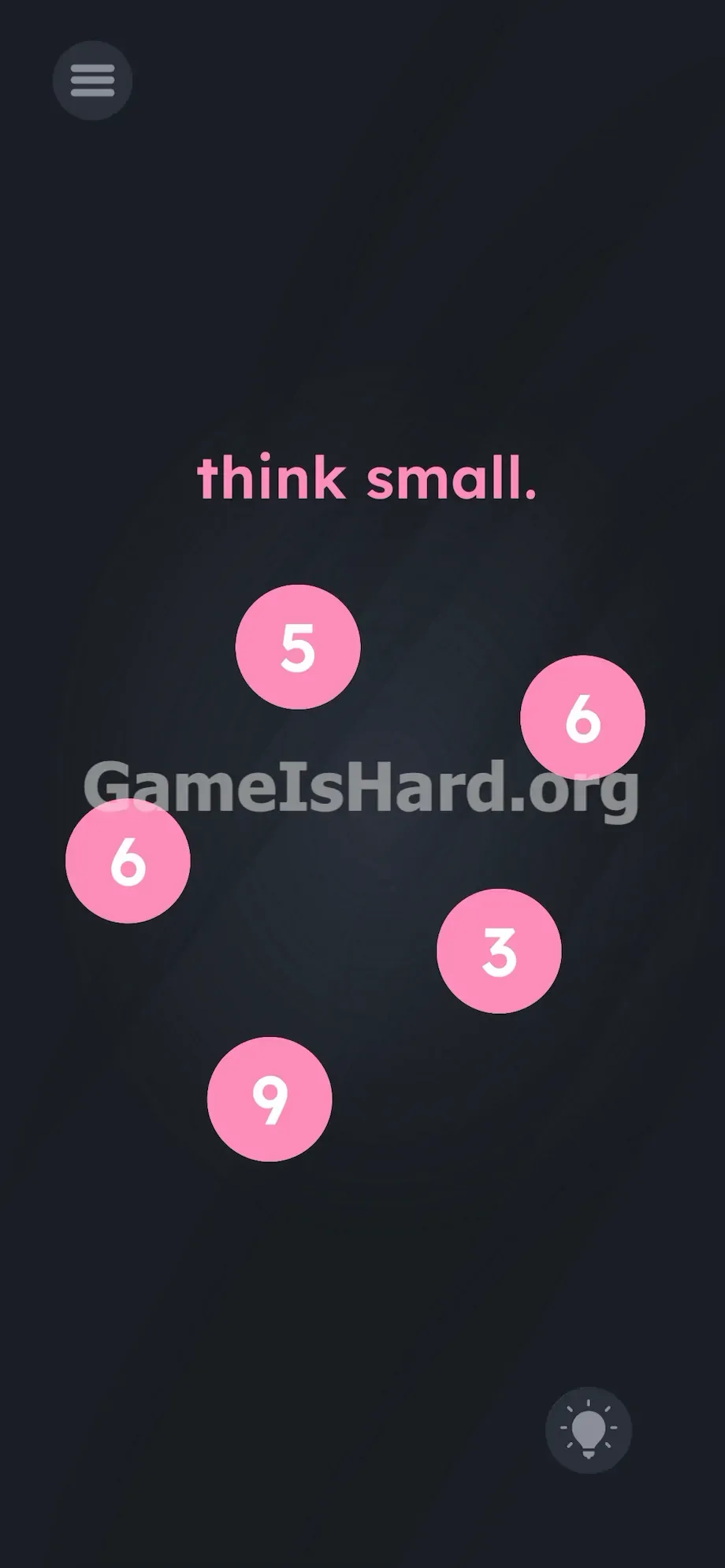
Below it, bright pink circular bubbles with white numbers scatter across the screen in an irregular, off-balance arrangement. In Wave 1, you’ll spot a 5 near the top, two 6s flanking left and right, and a 3 and 9 clustered near the bottom—all unevenly spaced.
After each completed wave, the old bubbles vanish and a fresh set appears. Later waves introduce negatives, repeats, and subtle font variations. Aside from those interactive bubbles, only two static UI elements exist: a hamburger menu icon in the top-left corner and a faint lightbulb hint button in the bottom-right. Nothing animates. Nothing blinks. Nothing distracts—except the puzzle itself.
Common Mistakes to Avoid
The Trap
The biggest pitfall? “UI Blindness” combined with inflexible thinking. We’re wired to process numbers as values first—so when you see a 5 and a 9, your brain defaults to comparing magnitudes. Once Wave 1 confirms that “smallest” = lowest number, your mind locks into math mode. Then Wave 2 strikes: you overlook how tiny that 5 looks on screen because you’re too busy scanning digits instead of sizing up typography. The game weaponizes that instinct.
First Instincts That Fail
Frustration leads players down rabbit holes. Some try dragging the phrase small. onto the bubbles, hoping to resize them—nothing happens. Others tap the physically tiniest bubble in Wave 3, only to fail because the rule reverted to numeric comparison. A few even rotate their phone, searching for hidden letterforms. Don’t bother—the numbers are just touch targets.
Player Reactions
I stared at those two 4s in Wave 4 longer than I’d care to admit. Tapped left—fail. Tapped right—fail. Yelled at my device. The level breaks its own one-tap convention purely to catch you off guard. That’s mobile puzzle design at its most cunning.
Step-by-Step Solution
Preparing the Move
Get both hands ready—this level demands dual-finger precision. You’ll tackle four waves consecutively. Don’t relax between rounds; failing Wave 4 sends you all the way back to Wave 1. Place your phone flat on a stable surface for full control over finger placement.
Executing the Solution
Follow these precise actions to clear all four waves.
- Round 1: Tap the pink circle labeled 3 . Among the visible digits, 3 is the numerically smallest—setting up your initial assumption.
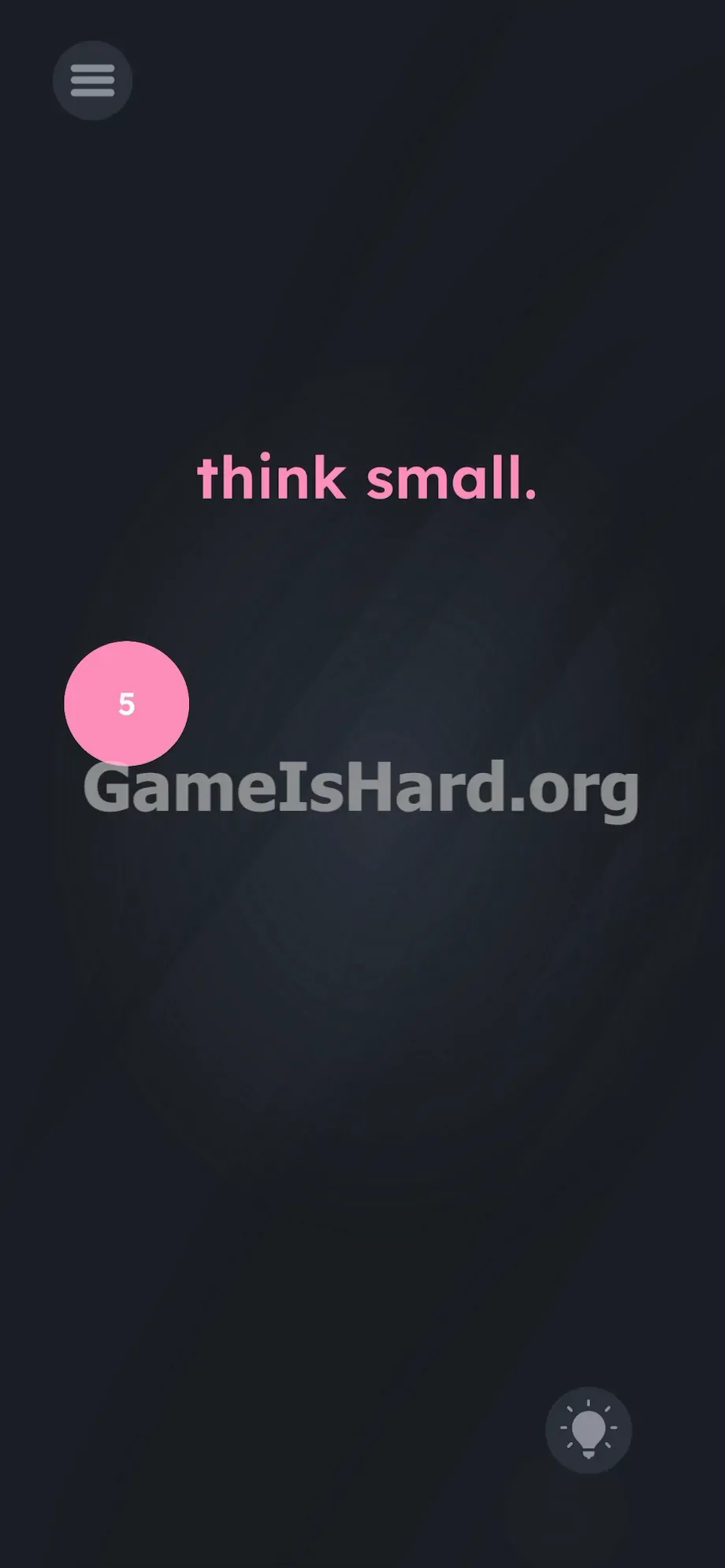
- Round 2: Ditch math. Focus on appearance. Tap the 5 rendered in the tiniest font—shifting the test to physical scale.
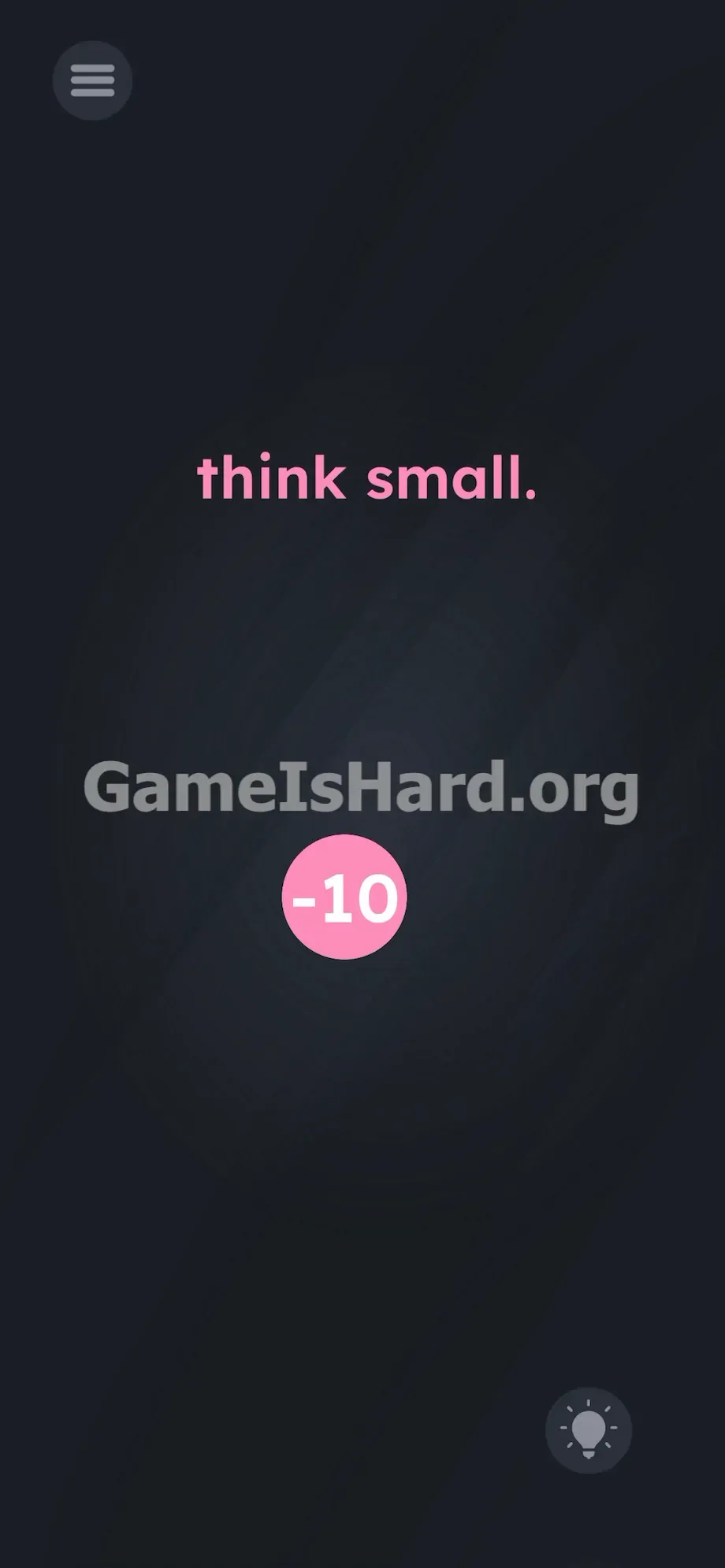
- Round 3: Return to numeric logic. Tap the bubble showing -10 . As a negative integer, it’s lower in value than any positive or zero.
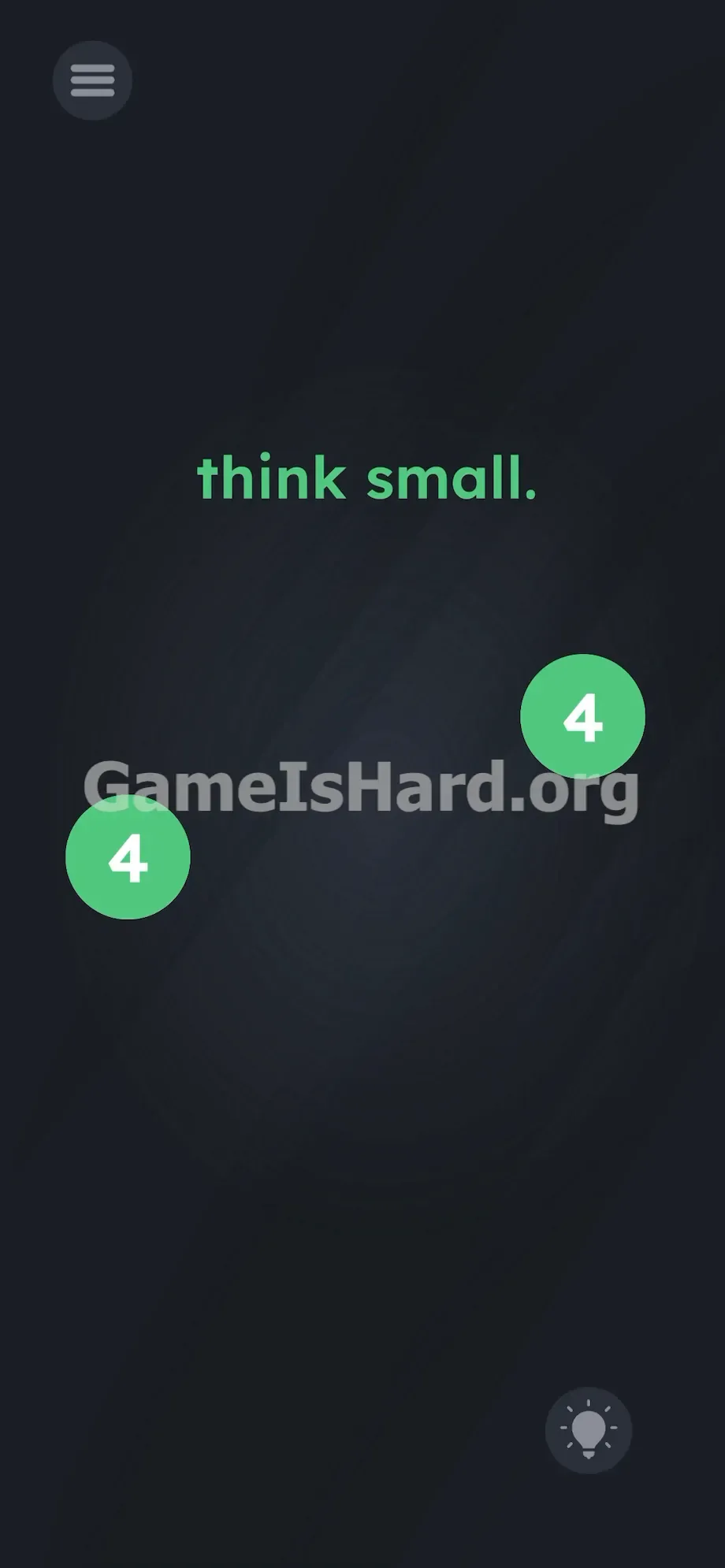
- Round 4: Two identical 4s appear—same value, same size. Use two fingers to tap both simultaneously.
If It Did Not Work
- Failing the multi-touch round: Your taps aren’t perfectly synced. The game registers microsecond gaps. Lay your phone flat, hover both index fingers just above the 4s, and press down together cleanly.
- Accidental taps: Avoid brushing the screen with your palm while reaching upward. Even light contact triggers false inputs—keep your grip clean and deliberate.
- Game freezing: Rapid tapping between waves can cause UI lag. If inputs stop registering, force-close the app and restart Game Is Hard Level 263.
Why This Solution Works
This level hinges on semantic flexibility—breaking down “think small” into multiple real-world interpretations: smallest numeric value, smallest typographic footprint, smallest integer (including negatives), and smallest plural selection (requiring dual input).
The text isn’t just instruction—it’s part of the puzzle. The real challenge lies in reading the UI, not the numbers. Your brain craves consistency, but Game Is Hard Level 263 thrives on subverting expectations—rewriting the rules mid-sequence just to watch you recalibrate.
Bonus Tip
Lock in the sequence before touching the screen. There’s no timer, but rhythm matters. Run through this mental checklist for a clean, sub-five-second solve:
- Math mode: Tap 3 .
- Visual mode: Tap the tiniest 5 .
- Math mode again: Tap -10 .
- Dual-input mode: Tap both 4s at once.
Skip interacting with the think small. text—it’s static. Don’t try moving bubbles—they’re fixed. Move decisively.
Frequently Asked Questions
Why did I fail Round 2 after tapping the lowest number? You missed the switch: Round 2 evaluates visual size—not numeric value. Find and tap whichever number is printed smallest, regardless of digit.
How do I pass the two-4 round? You must hit both circles at the exact same instant. One finger won’t cut it—use two. Tapping sequentially counts as incorrect and restarts the entire level.
Why is -10 correct in Round 3? The logic snaps back to pure mathematics. -10 holds a lower numeric value than any positive number displayed—making it the true “smallest” option.
Does the hint button help here? Rarely. It usually just repeats think small. or drops vague hints about rule changes. Save your lightbulbs for tougher levels and trust this proven sequence.
Can I drag the bubbles? No. They’re immovable. Your only valid action is tapping—don’t waste energy testing physics.
More Game Is Hard Solutions
We build these guides to be quick, direct, and clutter-free—so you spend less time searching and more time playing. Skip bloated video walkthroughs and go straight to the fix. If this got you unstuck, share it with friends battling the same puzzle. Every answer you need is right here—no signups, no ads, just solutions. Keep playing!