App updates can sometimes shuffle the order of puzzles. If this level 58 walkthrough doesn't match your screen, don't worry! You can browse our All Levels guide to find your exact puzzle by its picture.
(Clarification: You are removing the non-prime numbers, not selecting the correct ones.)
Level Overview
What Makes This Puzzle Tricky
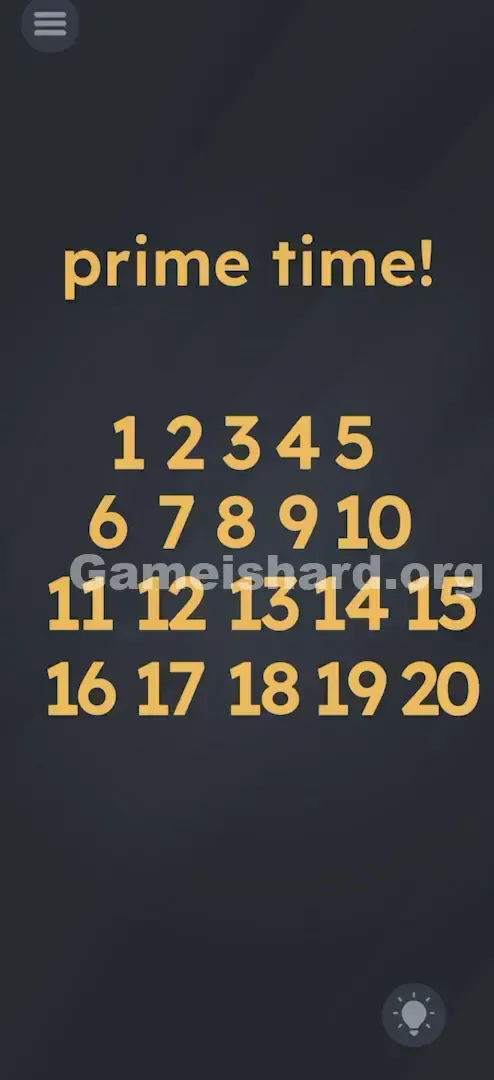
You land on the screen—and there it is: “Prime time!” in bold yellow. Below it sits a clean 4×5 grid of numbers from 1 to 20. Your brain immediately jumps to “tap the primes!” So you tap 2—nothing. Tap 3—still nothing. Try dragging? No response. That familiar “wait, what’s the trick?” moment hits. This isn’t about choosing the right answers—it’s about erasing the wrong ones. Classic misdirection.
Your Goal
Level 58 doesn’t ask you to highlight primes—it asks you to clear the board of everything that isn’t prime. “Prime time!” is your cue to keep only numbers divisible exclusively by 1 and themselves. Think of yourself as a digital bouncer: every composite number (and 1) gets the boot.
How the Game Responds
This puzzle hinges on four subtle but critical elements:
- Touch-to-Delete: A tap removes—not selects—the number.
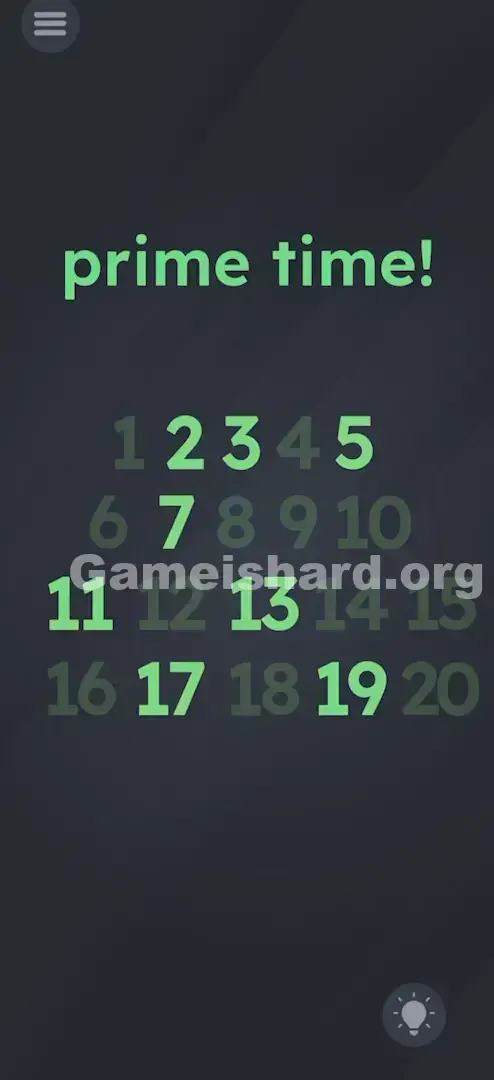
- Core Math Knowledge: You must recall which numbers under 20 qualify as prime (2, 3, 5, 7, 11, 13, 17, 19).
- The 1 Misconception: Many assume 1 is prime. It’s not—and leaving it behind will block completion.
- Reverse Logic: Success comes from elimination, not selection. It’s subtraction, not addition.
It’s less a math quiz and more a precision cleanup task.
What Appears on Your Screen
The screen opens with the game’s signature dark slate-gray background.
At the top, bold yellow text reads: prime time!
Beneath it, a uniform grid of bright yellow numbers fills the center—arranged neatly in four rows:
- Top Row: 1, 2, 3, 4, 5
- Second Row: 6, 7, 8, 9, 10
- Third Row: 11, 12, 13, 14, 15
- Bottom Row: 16, 17, 18, 19, 20
No buttons. No hints. No visual cues separating primes from composites. Everything looks identical—until you start tapping.
Common Mistakes to Avoid
The Trap
The biggest pitfall? Expecting standard mobile UI behavior. In nearly every other puzzle, tapping highlights or confirms. Here, tapping deletes. So when players instinctively tap 2, 3, and 5—thinking they’re “selecting” the answer—they’re actually wiping out the solution. One accidental tap on a prime means starting over.
First Instincts That Fail
- Dragging numbers: Some try to drag primes into a new area or stack them—but the numbers won’t budge.
- Shaking the device: A common reset or sorting gesture elsewhere, but it has zero effect here.
- Leaving 1 untouched: A frequent oversight. Since 1 feels “simple,” many forget it’s excluded from the prime definition—and the level won’t complete if it remains.
Player Reactions
I tapped 2, then 3, then 5… watching each vanish. “Maybe I’m supposed to clear the primes to prove I recognize them?” I wiped them all—and stared at a screen full of 4, 6, 8, and 9. Then it clicked: I’d just tossed the gold and kept the gravel.
Step-by-Step Solution
Preparing the Move
Before tapping anything, scan the full grid (1–20). Resist the urge to tap any prime—2, 3, 5, 7, 11, 13, 17, or 19. Those must stay. Your targets are the remaining twelve numbers.
Executing the Solution
- Identify the Composites (and 1): You are going to tap the numbers that are NOT prime.
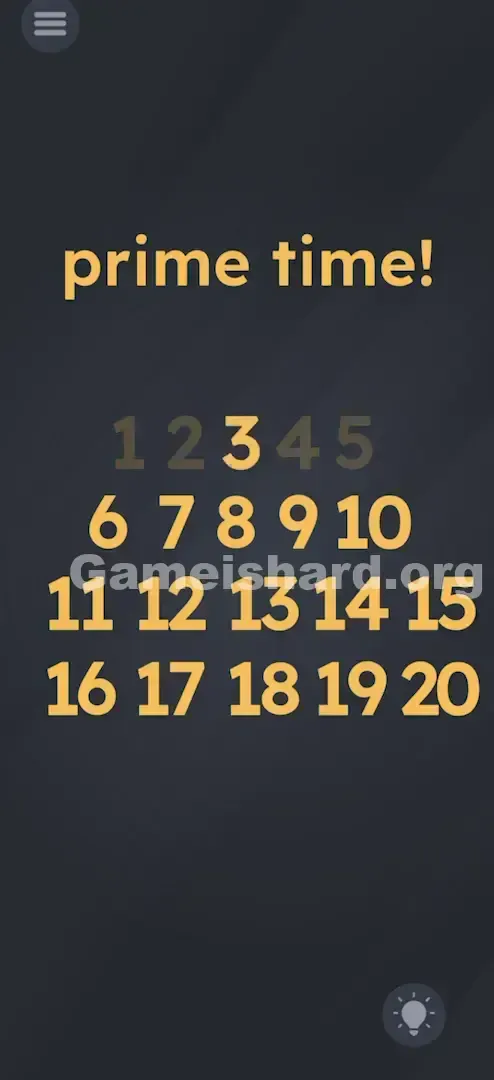
- Tap 1: It fades out. (Crucial first step).
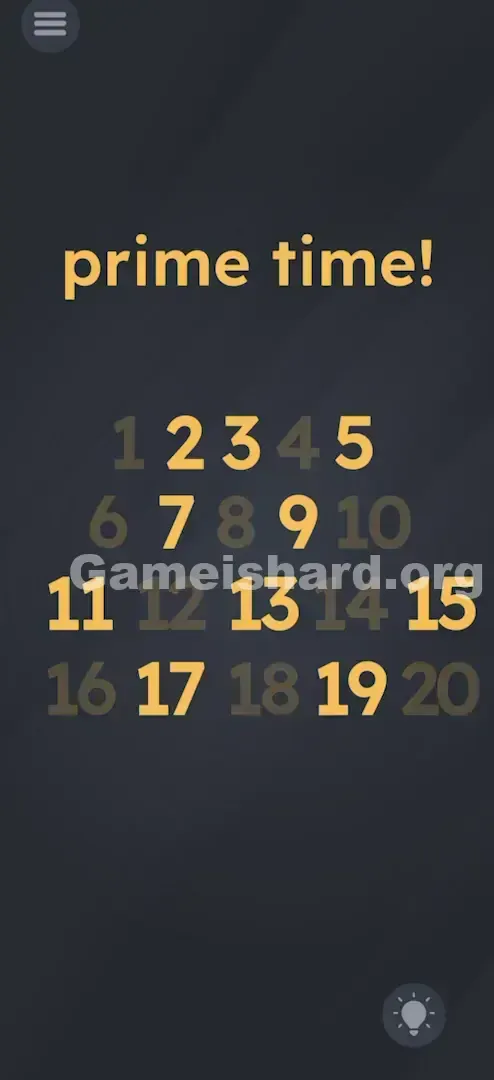
- Tap 4, 6, 8, 9, 10: These are the non-primes in the top two rows.
- Tap 12, 14, 15: These are the non-primes in the third row.
- Tap 16, 18, 20: These are the non-primes in the bottom row.
- Verification: Once the last non-prime number is tapped and fades away, the level will automatically complete.
If It Did Not Work
- "I tapped all the non-primes but nothing happened." Double-check the number 9 and the number 15 . These are tricky because they look odd, but they are divisible (9 by 3, 15 by 3 and 5). Also, make sure you deleted 1 .
- "I accidentally tapped a prime." There is no undo button. You must restart the level.
Why This Solution Works
This level tests subtractive problem-solving—a deliberate shift from the usual “build up” approach. Instead of assembling the answer, you refine it by stripping away noise.
Two core skills are assessed:
- Foundational Math Recall: Can you name all primes under 20 without hesitation?
- UI Awareness: Can you spot when the interaction flips—from “choose this” to “remove this”?
It’s textbook Game Is Hard: the instruction is literal (“prime time!”), but the path to fulfilling it requires rethinking how you interact with the screen.
Bonus Tip
For faster clears—especially during speed runs—skip calculating each number. Memorize the “Remove List” instead:
- 1
- All even numbers greater than 2 (4, 6, 8, 10, 12, 14, 16, 18, 20)
- Odd composites under 20: 9 and 15
That’s just three categories: “delete 1,” “delete evens >2,” and “delete 9 and 15.” Done.
Game Is Hard Level 58 FAQ (Short, Useful)
Q: Is 1 a prime number in this game in Game is hard Level 58? A: No. In standard math (and this game), 1 is not prime. You must tap it to remove it.
Q: I cleared everything except the primes but the level won't end in Game is hard Level 58? A: You likely missed one sneaky composite number. Check if 9 or 15 is still on the screen. Also verify 1 is gone.
Q: Can I get the numbers back if I tap the wrong one in Game is hard Level 58? A: No. There is no undo function. If you delete a prime number (like 2, 3, or 5), you must restart the level.
Q: Why is 2 a prime number in Game is hard Level 58? A: A prime number has exactly two factors: 1 and itself. 2 fits this rule. It is the only even prime. Keep it on the screen.
More Game Is Hard Solutions
If you found this guide for Game is hard Level 58 helpful, we have the solutions for the rest of the game too. Our guides cut out the fluff and tell you exactly where to tap and what to drag. Bookmark us for when the game inevitably tries to trick you again in the next few levels. Good luck!