App updates can occasionally shift puzzle positions. If this level 239 guide doesn’t match what you’re seeing, no stress! Flip through our All Levels hub to locate your exact puzzle by image.
You’ll need to lift each colored square upward into the blank space above—ranking them by vertical position, not horizontal placement.
Level Overview
What Makes This Puzzle Tricky
You’re staring at five static colored squares and a cryptic phrase that feels like nonsense. The interface offers zero feedback. The clue gives you half the picture and expects you to deduce the rest. Yep—it’s another classic “Game Is Hard” mind-bender. And yes, the game wants you to misread its instructions. We’re wired to sort things left-to-right—but that instinct is exactly what’s holding you back.
Your Goal
Use the primary color ranking (red > blue > yellow) to deduce the relative values of the secondary colors—purple and orange—then map those values to literal vertical height on your screen. You’re not solving a riddle—you’re constructing a live, draggable bar chart using UI elements.
This level hinges on four core mechanics:
- UI drag: These aren’t decorative icons—they’re interactive objects you must physically reposition.
- Logic trap: The hint only names primary colors; you must infer secondary values from real-world color mixing.
- Hidden rule: “Higher” means actual pixel elevation—not larger numbers or stronger intensity.
- Spatial precision: There’s no grid or alignment aid. You control spacing manually—and every box’s Y-coordinate matters.
It’s not a mistake. It’s intentional design.
What Appears on Your Screen
The screen is stripped down to essentials. Two-thirds of the top area is pure dark void—empty, silent, and easy to overlook.
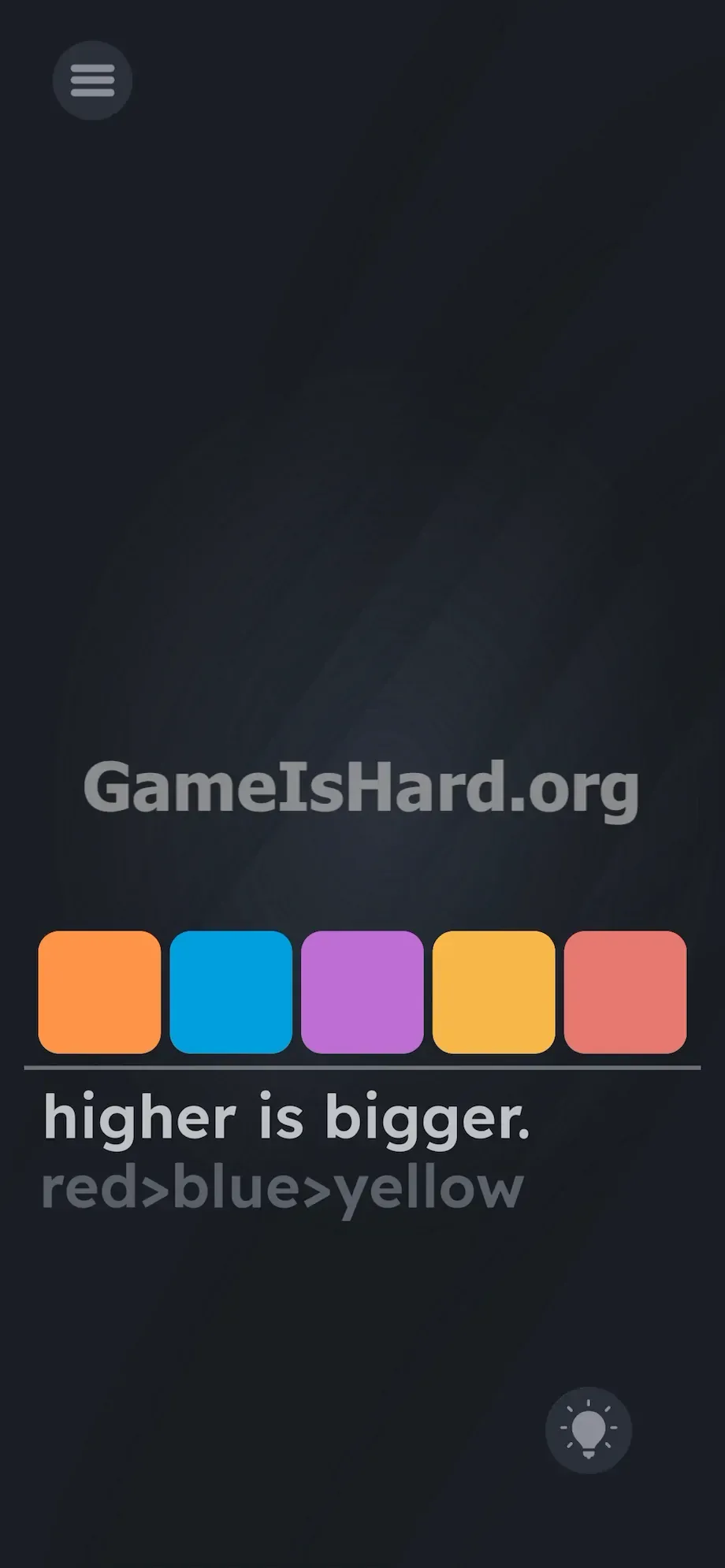
Near the bottom, aligned along a thin gray divider line, sits a row of five identical square blocks: orange , blue , purple , yellow , and red —left to right.
Directly beneath the divider is your main prompt: higher is bigger. Below that, faded text reads: red>blue>yellow .
A hamburger menu hides in the top-left corner; a glowing lightbulb icon rests in the bottom-right. Nothing blinks. Nothing animates. The puzzle waits—quietly—for you to reinterpret the emptiness as opportunity.
Common Mistakes to Avoid
The Trap
UI autopilot. We scan text and treat it as direction—not physics. When “higher is bigger” appears, our brains default to numerical sorting, assuming left-to-right arrangement. We try lining up boxes on the gray line. That horizontal reflex? It’s the puzzle’s built-in roadblock. This one demands vertical thinking—literally.
First Instincts That Fail
Players tap boxes hoping for color shifts—nothing happens. Others drag red onto blue, trying to “mix” them into purple—no response. Some even attempt dragging the hint text itself into the void. None of it works. You can’t merge boxes. You can’t edit text. You can’t trigger hidden animations. The only valid action is vertical dragging.
Player Reactions
I spent nearly ten minutes arranging all five boxes neatly along the bottom gray line—reordering them left-to-right, testing red-first, then yellow-last. Then I finally looked up. That vast empty zone wasn’t just dead space. It was the board. The solution was already visible—I just hadn’t seen it.
Step-by-Step Solution
Preparing the Move
Pause. Read the hint again: red>blue>yellow . Treat it like a scoring system. Assign values: red = 3, blue = 2, yellow = 1.
Now consider purple and orange —the remaining colors. Purple forms from red + blue → 3 + 2 = 5. Orange comes from red + yellow → 3 + 1 = 4.
That gives you the full ranking: Purple (5) > Orange (4) > Red (3) > Blue (2) > Yellow (1).
Executing the Solution
Now convert that sequence into vertical placement:
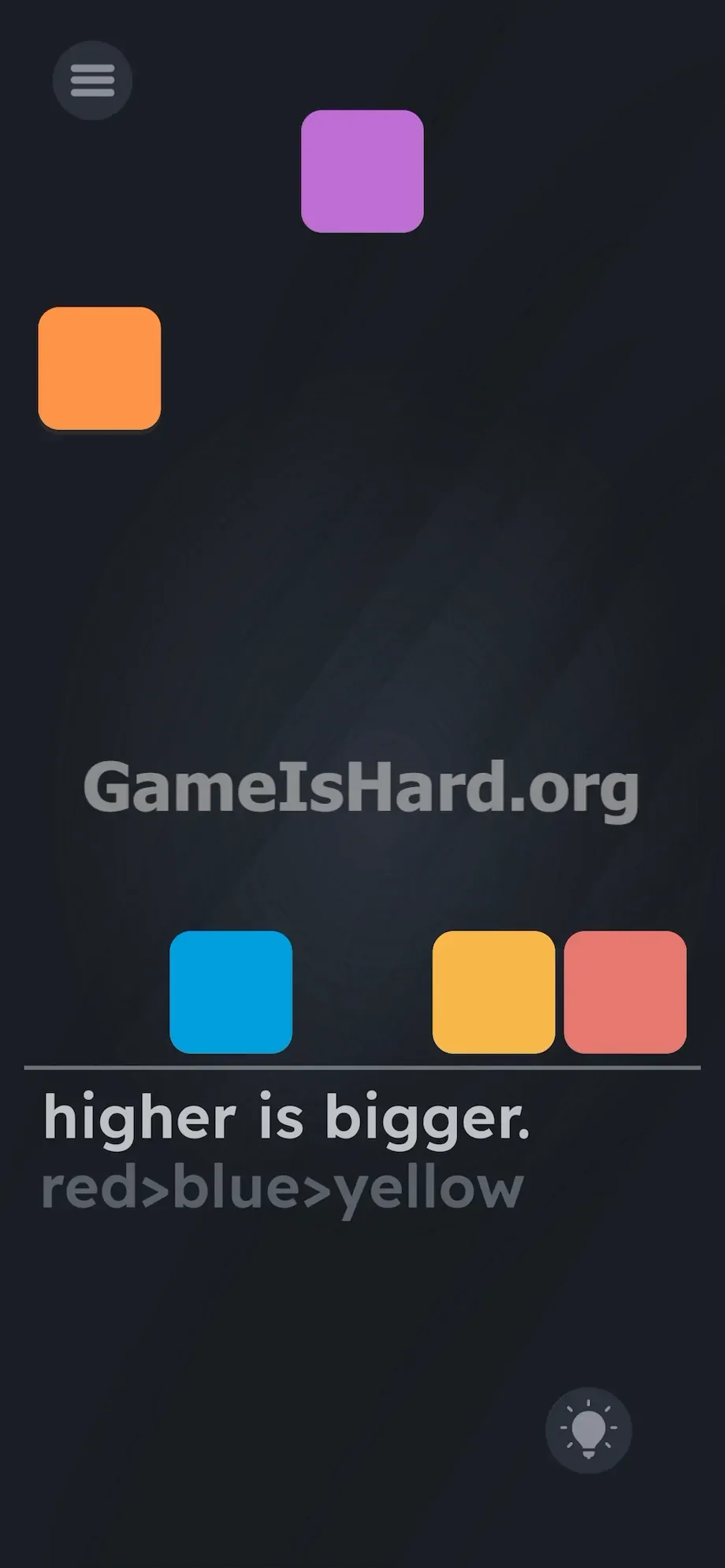
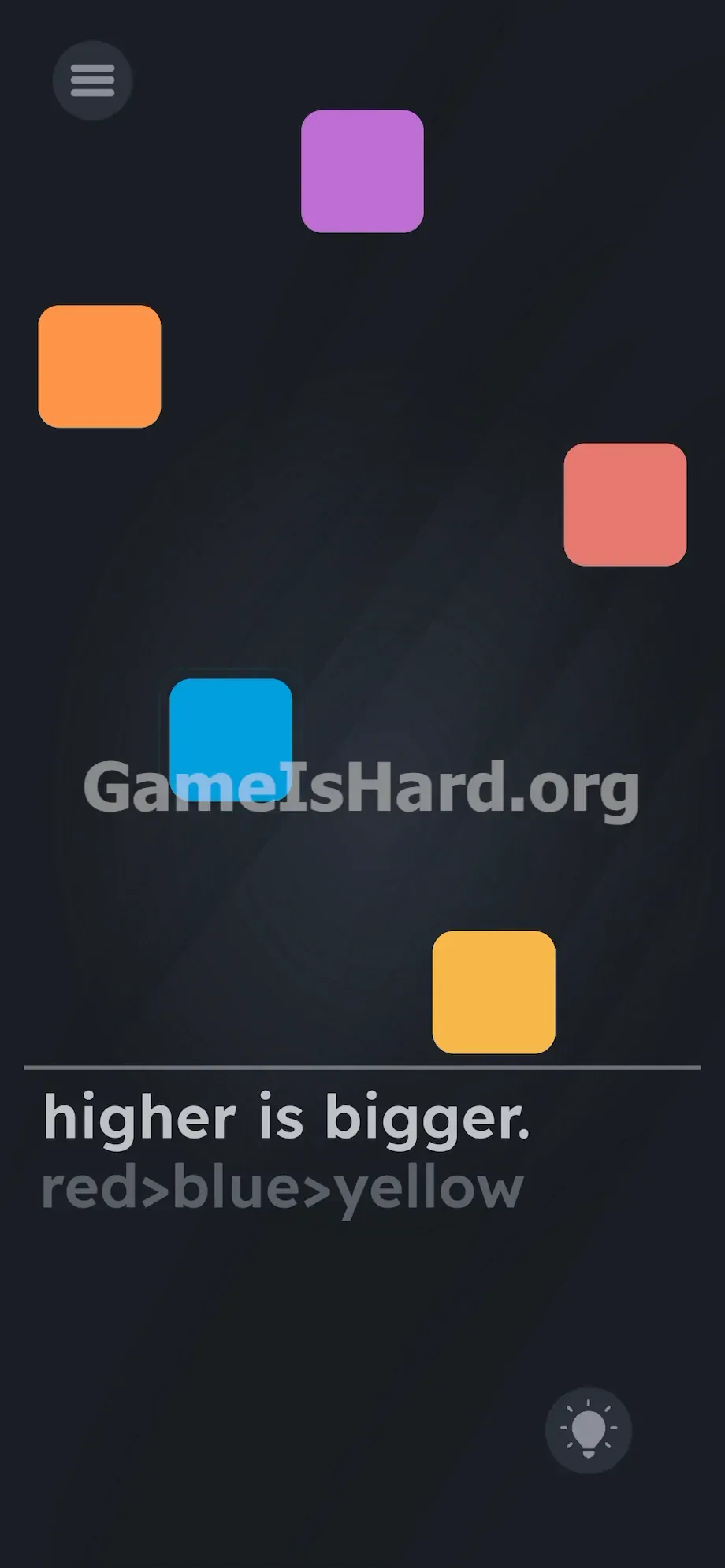
- Press and hold the purple box. Drag it straight up—top edge of your screen—no exceptions.
- Grab the orange box. Place it directly beneath purple, leaving clear space between them.
- Lift the red box next—center it mid-screen, just under orange.
- Move the blue box up slightly, positioning it under red.
- Leave yellow exactly where it is—on the gray line at the bottom.
The level clears the instant the vertical order matches Purple > Orange > Red > Blue > Yellow .
If It Did Not Work
Even with correct ordering, the level may stall. Try these fixes:
- Add breathing room. Overlapping boxes—even slightly—can confuse the engine’s height detection. Space them generously.
- Maximize vertical range. If purple isn’t high enough, you’ll run out of room to place others accurately. Pin it flush against the top bezel.
- Avoid extreme horizontal drift. While X-position doesn’t affect scoring, dragging boxes too far left/right can interfere with touch responsiveness. Keep them roughly centered.
Why This Solution Works
This level rewards literal interpretation over conceptual guesswork. Throughout the game, metaphors become mechanics—and “higher is bigger” is no exception. Here, “higher” means altitude, not magnitude. Abstract reasoning gets you stuck; physical manipulation gets you through.
The color hierarchy serves as a disguised arithmetic test. Using basic additive color theory (red + blue = purple, red + yellow = orange), the game forces you to calculate unseen values—then translate those numbers into spatial relationships. The text is misdirection. The blank space is the puzzle.
Bonus Tip
Forget symmetry. Forget neat columns. The game checks only Y-coordinates.
- Launch purple to the ceiling—immediately.
- Drop orange just below it.
- Set red halfway down.
- Float blue a bit lower.
- Leave yellow untouched on the baseline.
As long as their vertical positions reflect that exact sequence, you pass—even if they’re scattered across the screen.
Frequently Asked Questions
Why does purple go at the absolute top? Because red and blue are the two highest-ranked primaries (3 and 2), and purple combines them—giving it the highest total value (5). Since “higher is bigger,” the biggest value must occupy the highest point on screen.
Do I need to physically combine the colored boxes? No. Stacking them or dragging one onto another has no effect. You only need to apply color-mixing logic mentally to determine rank.
Does horizontal alignment matter? Not at all. Purple can be on the far left, orange on the far right—the game ignores X-axis position entirely. Only vertical height counts.
What if the level won’t confirm despite correct stacking? Check for subtle vertical overlap—especially between purple and orange. If their Y-values are too close, the engine may misread the order. Widen the gaps across the full screen height.
More Game Is Hard Solutions
Stuck on the next challenge? We break down every trick, invisible button, and logic twist in the game—fast, accurate, and zero filler. Share this guide with anyone currently yelling at their phone.
Keep dragging. Keep experimenting. And remember: the game’s words are clues—not commands. You’ve got this.