
App updates can occasionally shift puzzle order. If this level 186 guide doesn’t match what you’re seeing, no stress! Flip through our All Levels directory and locate your exact puzzle by image.
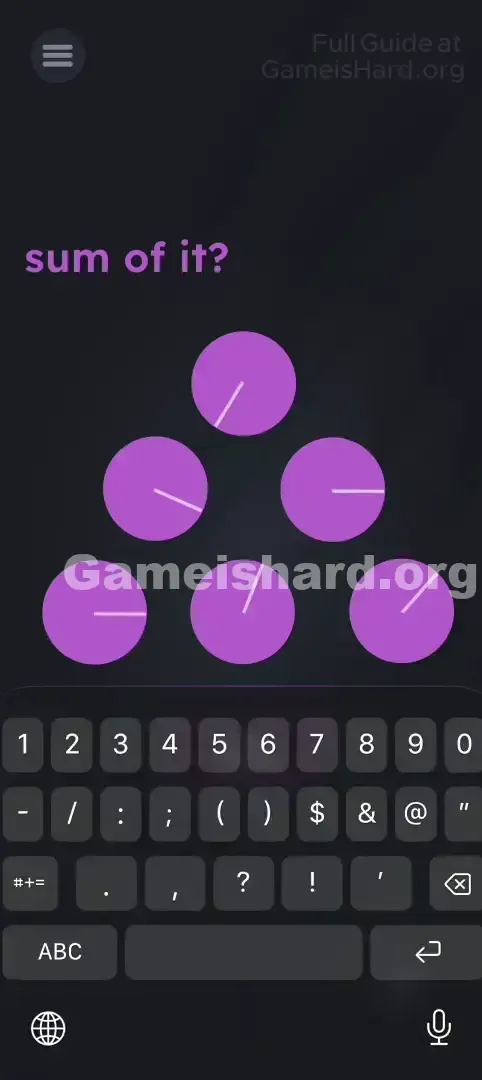
Just tap the input box at the bottom and enter the number.
Level Overview
What Makes This Puzzle Tricky
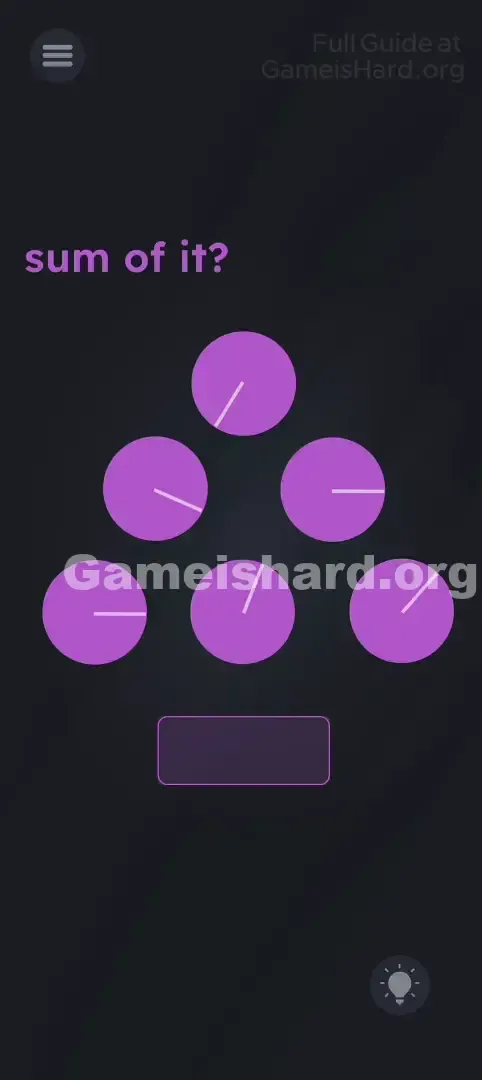
You’re met with six simple purple circles—each holding a single white line. The prompt says “sum of it?” but there are zero digits in sight. No equations, no labels—just clean, cryptic shapes. It feels less like a logic puzzle and more like decoding minimalist art.
Your Goal
Your job is to recognize what real-world object these circles symbolize, then pull out the numbers they represent. Once decoded, all that’s left is basic addition.
Key Mechanics
- Visual Metaphor: These aren’t arbitrary blobs—they’re stripped-down representations of something familiar.
- Pattern Recognition: You’ll convert direction and position into meaningful numbers.
- Hidden Data: The values aren’t printed—they’re embedded in orientation. This isn’t about guessing. It’s about interpreting visual shorthand.
What Appears on Your Screen
The background is dark and minimal. At the top, plain text reads: sum of it?
Below it sits a neat pyramid of six purple circles. Each contains one white line radiating from center to edge—each pointing in a slightly different direction.
At the bottom, a blank input field waits for your numeric answer. The ultra-clean layout actually works against you—it removes any visual noise that might hint at meaning.
Common Mistakes to Avoid
The Trap
Most players overcomplicate it—searching for angles, measuring arcs, or counting circles. Your brain jumps to geometry because circles + lines = math class. But here, it’s not math—it’s timekeeping.
First Instincts That Fail
- Trying to drag or rotate the circles to reveal hidden numbers.
- Counting how many circles there are (6) and entering that number.
- Interpreting the lines as operators—like minus signs or division symbols.
- Shaking or tilting the device hoping for animation or clues.
Player Reactions
I stared at it for nearly 60 seconds convinced it was about symmetry or shape counts. Then I glanced at my wristwatch—and instantly groaned. “Oh—it’s clocks.” Obvious in hindsight, impossible before the click.
Step-by-Step Solution
Preparing the Move
Skip the colors and shapes. Zero in on those white lines inside each circle. Picture a standard analog clock face overlaid on every one.
Executing the Solution
- Read the clocks: Note where each white line points and assign its corresponding hour. Top circle: Points to 7 o'clock. Middle Left: Points to 4 o'clock. Middle Right: Points to 3 o'clock. Bottom Left: Points to 3 o'clock. Bottom Middle: Points to 1 o'clock. Bottom Right: Points to 2 o'clock.
- Top circle: Points to 7 o'clock.
- Middle Left: Points to 4 o'clock.
- Middle Right: Points to 3 o'clock.
- Bottom Left: Points to 3 o'clock.
- Bottom Middle: Points to 1 o'clock.
- Bottom Right: Points to 2 o'clock.
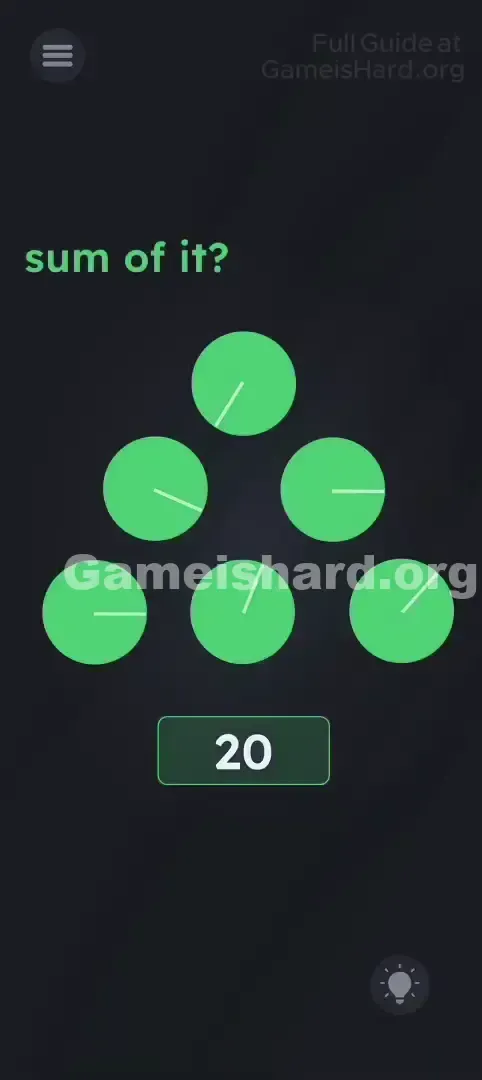
- Do the math: Add them all up. 7 + 4 + 3 + 3 + 1 + 2 = 20 .
- 7 + 4 + 3 + 3 + 1 + 2 = 20 .
- Enter the code: Tap the input box at the bottom.
- Finish it: Type 20 and hit enter.
If It Did Not Work
- Math error: Most missteps come from mistaking the “4” for a “5” or the “1” for a “2”. The lines land precisely—when it points down-right, it’s 4—not 5—in this puzzle.
- Typo: Double-check that you didn’t accidentally press space or a letter while typing.
Why This Solution Works
This level relies on symbolic abstraction. It strips away everything non-essential from a clock—the numbers, the markings, even the frame—leaving only the core idea: a hand indicating time.
It challenges you to map an abstract visual cue (a line in a circle) to a concrete value (an hour). That’s lateral thinking—not arithmetic. Once you make that mental leap, the calculation is effortless.
Bonus Tip
If future levels leave you scratching your head:
- Look for “Clocks”: Any circle with a centered line almost always represents an analog clock.
- Watch for “Pizza”: Circles with lines can also indicate fractions (like slices), but context usually clarifies.
- Skip angle math: The game rarely demands precise degree measurement (e.g., 37°). Expect clean, whole-number values—especially hours.
Frequently Asked Questions
Why is the answer 20? Each circle functions as a clock face. The hands point to 7, 4, 3, 3, 1, and 2. Adding them gives 20.
Is there a trick to reading the clocks? Anchor your mental clock: 12 at the top, 3 on the right, 6 at the bottom, 9 on the left. That grid makes identifying the hour much faster.
Does the order of the circles matter? Not at all—addition is commutative. Whether you start at the top or bottom, just ensure all six are included.
Do I need to adjust my phone’s time? Nope. This puzzle lives entirely within the app—no system settings, no external tools needed.
More Game Is Hard Solutions
Stuck on the next challenge? We’ve got step-by-step answers ready. Our guides are built for speed—because solving should feel satisfying, not slow. Share this with anyone still trying to measure angles with their finger!