App updates can sometimes shuffle the order of puzzles. If this level 127 walkthrough doesn't match your screen, don't worry! You can browse our All Levels guide to find your exact puzzle by its picture.
You are physically constructing the answer using the existing numbers on the grid.
Level Overview
What Makes This Puzzle Tricky
You’re faced with a simple-looking grid — but that lone question mark in the corner throws everything off. No keyboard appears. No input field shows up. It feels like the puzzle is missing half its pieces — a signature Game is hard mind-bend.
Your Goal
Your job is to determine the missing value in the sequence — a deceptively straightforward math puzzle wrapped in UI misdirection. You’ll need to deduce the correct number and figure out how to place it without any obvious tools.
Key Mechanics
- Pattern Recognition: It’s built around a multiplication table.
- UI Drag: Those numbers scattered across the grid? They’re not fixed — they’re draggable assets.
- Object Merging: Combine two single digits to form a two-digit number directly on the board. It’s less about solving equations and more about realizing the puzzle itself is the solution manual.
What Appears on Your Screen
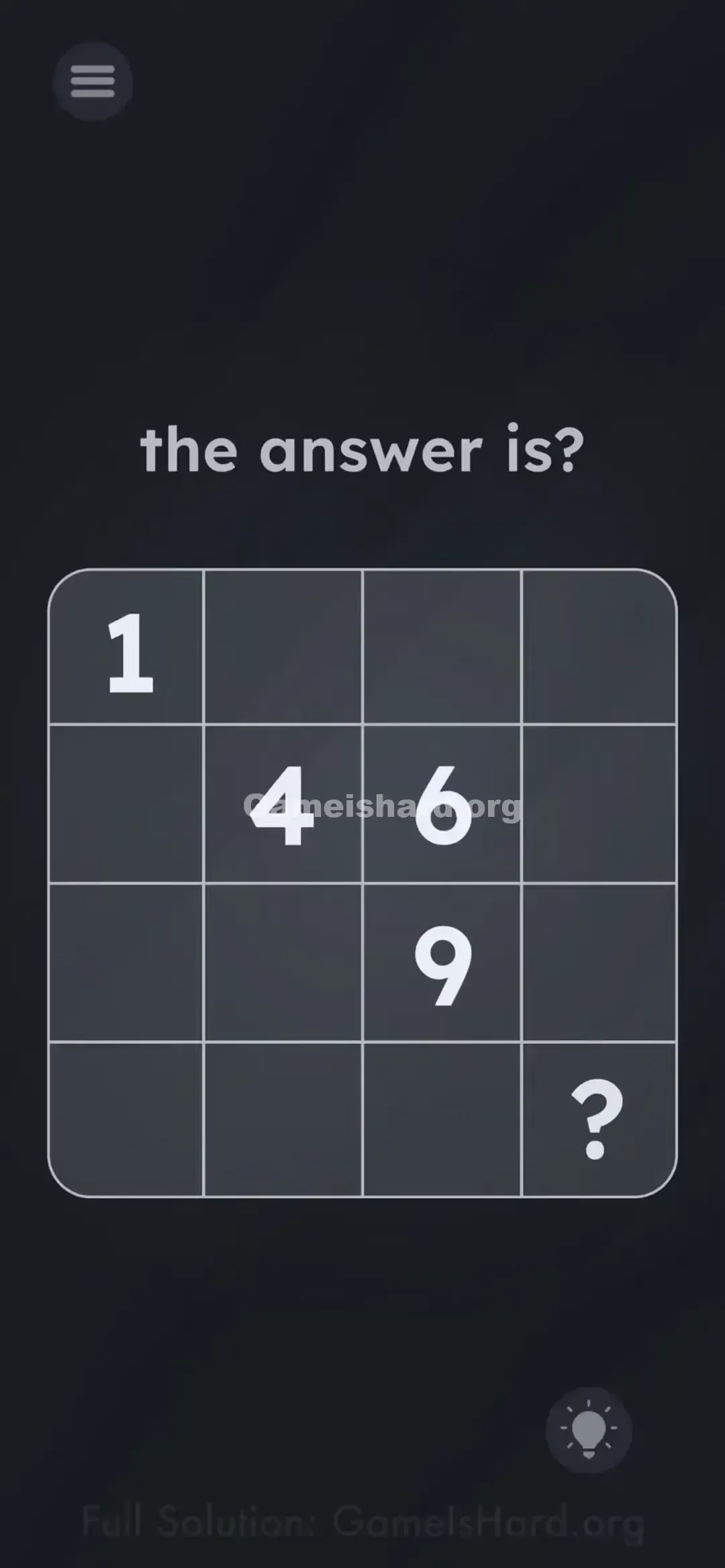
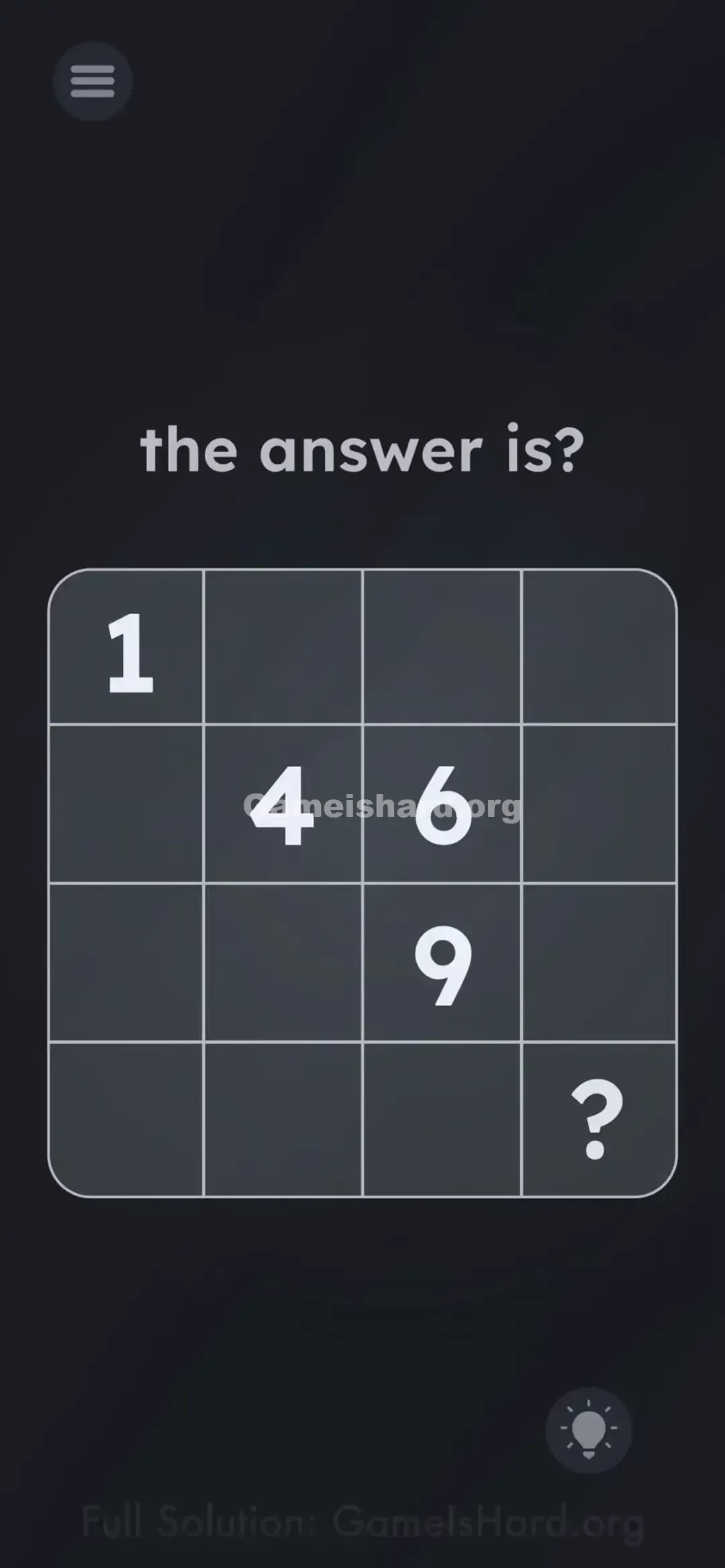
The screen centers on a dark grey $4\times4$ grid.
- Top Left (Row 1, Col 1): The number 1 .
- Middle (Row 2, Col 2): The number 4 .
- Middle Right (Row 2, Col 3): The number 6 .
- Lower Middle (Row 3, Col 3): The number 9 .
- Bottom Right (Row 4, Col 4): A large ? symbol. Above the grid, the prompt reads plainly: the answer is? That’s all — no hints, no buttons, no extra elements.
Common Mistakes to Avoid
The Trap
The biggest mental roadblock? “Keyboard Expectation.” When you see a ? or a math prompt, instinct says type something. You tap the question mark, hoping for a keypad — but nothing happens. That pause of confusion is exactly where Game is hard wants you.
First Instincts That Fail
- Tapping the ?: Triggers zero response.
- Shaking the phone: A go-to trick in many levels, but completely ineffective here.
- Dragging the ? away: It’s not an object — it’s a placeholder. Nothing hides beneath it.
- Searching for ‘16’: Many spot the answer quickly but waste time scanning corners or backgrounds for a pre-made 16 .
Player Reactions
I spent over two minutes overthinking diagonals, sums, and hidden logic — convinced it was a sudoku variant or magic square. Then I accidentally dragged the '1' while wiping my screen and realized: these aren’t static labels. They’re movable tiles — like fridge magnets on a whiteboard.
Step-by-Step Solution
Preparing the Move
Start by spotting the pattern: it’s a diagonal progression of squared numbers:
- 1 x 1 = 1
- 2 x 2 = 4
- 2 x 3 = 6
- 3 x 3 = 9
- 4 x 4 = ? (The answer is 16 ) And yes — the 1 and 6 you need are already placed on the board.
Executing the Solution
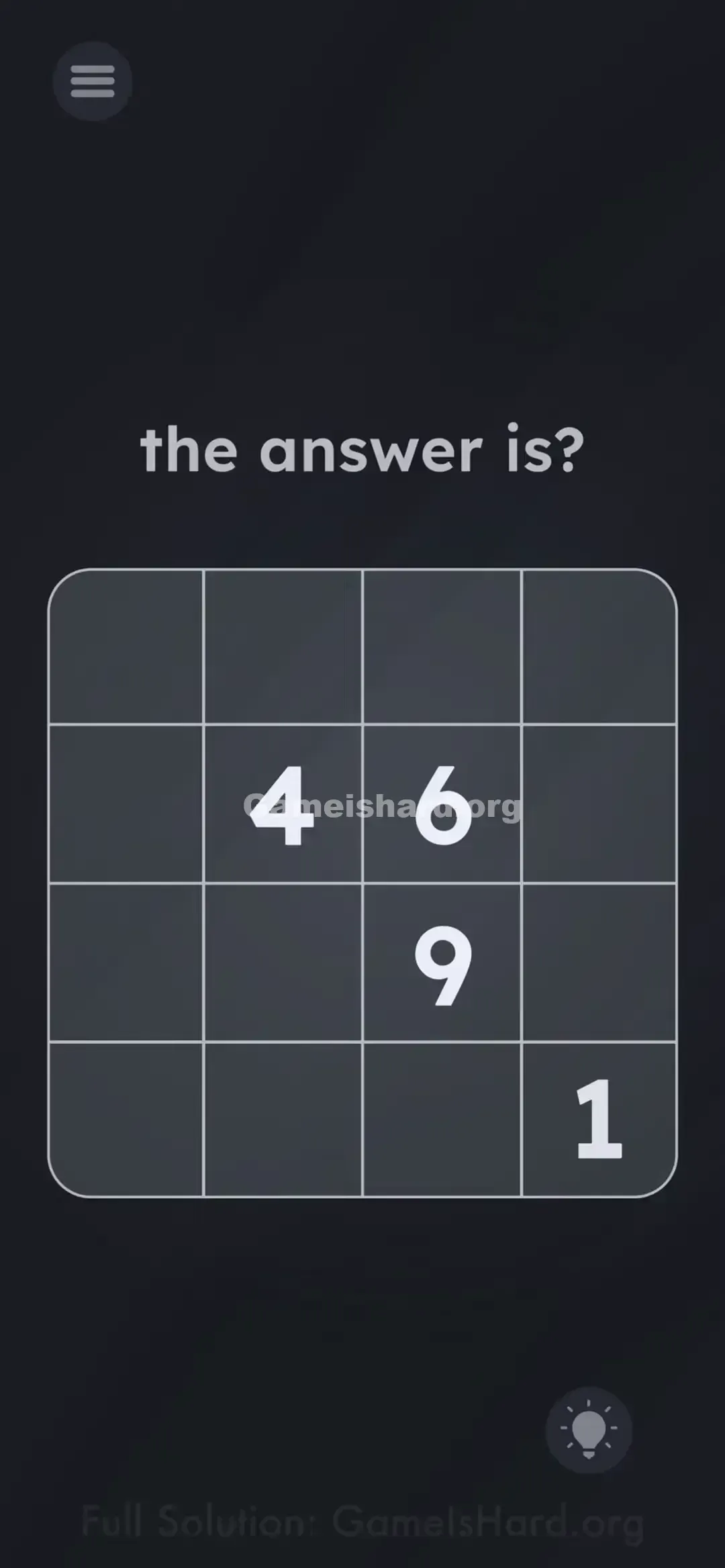
- Tap and hold the number 1 from the top-left corner.
- Drag it all the way down to the bottom-right square (the one with the ? ). Drop it there. The ? may vanish or remain, but the 1 will lock in place.
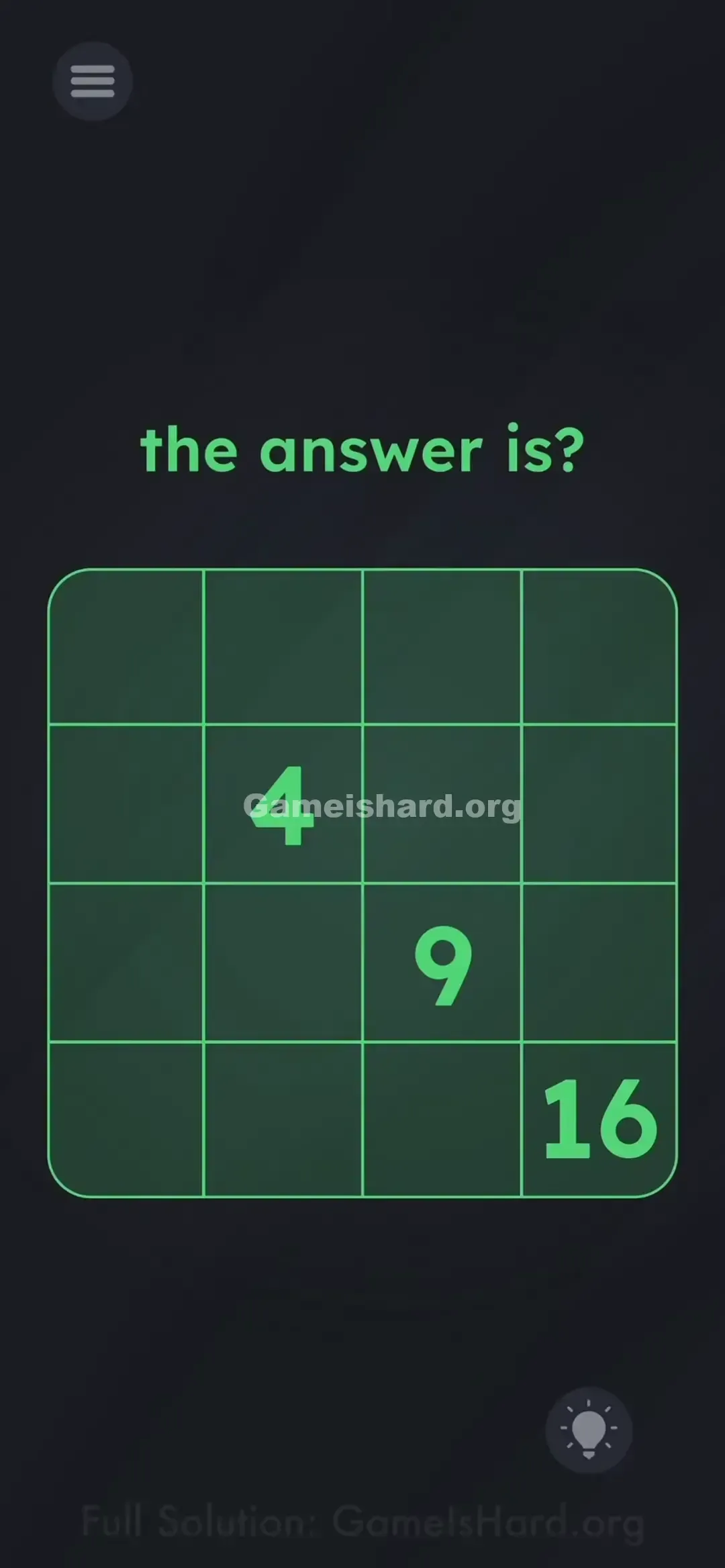
- Tap and hold the number 6 from the middle of the grid.
- Drag it next to the 1 you just placed in the bottom-right square.
Confirming It Worked
Once both digits sit side-by-side inside that final box, the game interprets them as “16” and instantly completes the level.
If It Did Not Work
- Order matters: Dropping the 6 first could form “61”. If nothing registers, remove both numbers and drop the 1 first (left position), then the 6 (right position).
- Precision: Place them fully inside the bottom-right cell — dropping near the edge may cause them to snap back.
Why This Solution Works
This level tests two core skills: basic arithmetic fluency and UI awareness — specifically, the “Text is Object” principle.
The math itself is simple squares ($1^2, 2^2, 3^2, 4^2$). But the real challenge is unlearning assumptions — most apps treat on-screen text as untouchable. Game is hard flips that: every visible digit is a tool. By forcing you to build the answer from the puzzle’s own elements, it skips clunky interfaces and reinforces its central idea — use what’s already there.
Bonus Tip
If you're speedrunning or replaying:
- Skip the pattern analysis — you already know the answer is 16.
- Grab the 1 immediately and drop it in the bottom-right corner.
- Grab the 6 right after and slot it beside the 1.
- Don’t wait for animations or visual feedback. Skip distractions: Tapping the ? or dragging the 4 or 9 serves no purpose — they’re red herrings.
Frequently Asked Questions
Why is the answer 16? The grid maps the squares of consecutive integers along a diagonal path: 1² = 1, 2² = 4, 3² = 9, so 4² = 16.
Can I flip the 9 to make a 6? Clever idea — but no rotation mechanics exist here. You must use the visible 6.
The numbers keep snapping back! What am I doing wrong? You’re not releasing them dead-center inside the bottom-right cell. Aim for the middle — not the border.
Do I need to move the 4? Nope. It’s part of the visual pattern clue — not an interactive element in the solution.
More Game Is Hard Solutions
Stuck on the next puzzle? We write these guides to be fast, cheat-free, and searchable so you can get back to gaming. Bookmark us or share this link with your Discord group if they’re stuck on the same level. Good luck!